Is It Cheaper to Rent or Buy in Summerside Right Now?RE/MAX Harbourside Realty | Darcey Busch, REALTOR®, SalespersonUpdated September 2026Right now in Summerside, the average new apartment rents
Dated: August 27 2026
Views: 279
 PEI First-Time Buyer Mortgage Rules: Your Complete Guide to Buying on the Island
When I started working with first-time home buyers as a REALTOR®, I was shocked at how many programs exist that most people don't know about. I kept hearing the same thing over and over: "I thought I needed $80,000 saved just to talk to a lender." It's not true.
Between federal programs, PEI-specific help, and rules that changed in 2024, there's real money available to first-time buyers on the island — but you have to know where to look. So I put this together.
Updated: August 2026
No. This was my biggest misconception, and I see it all the time.
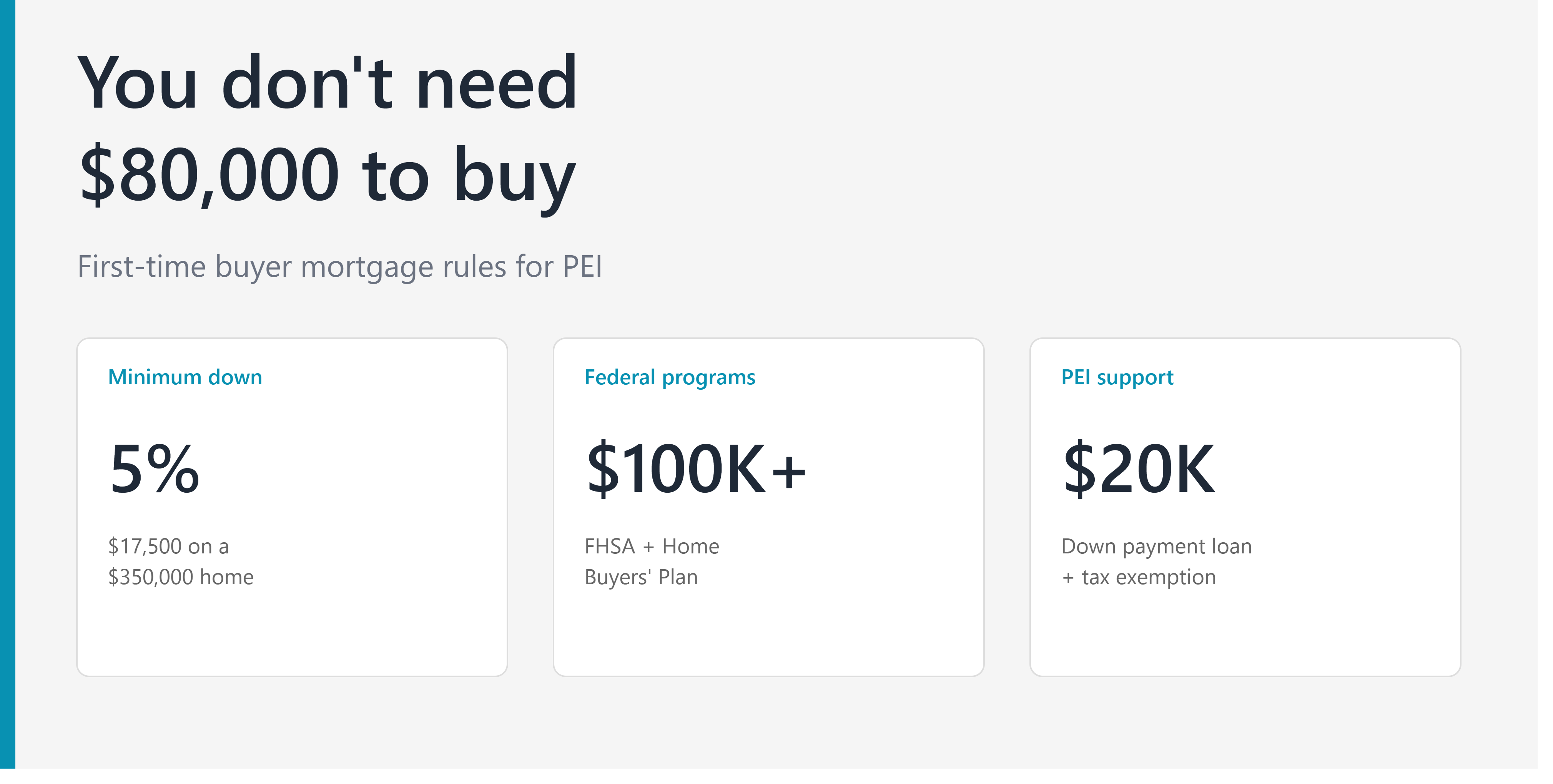
You can buy with just 5% down. That sounds small, but on a $350,000 house, that's only $17,500. The bank lends you the other $332,500 — which is how mortgages work.
Here's the thing: if you put down less than 20%, the bank charges you insurance. It protects them in case you default. On that $350,000 home with 5% down, insurance adds roughly $12,000 to $16,000 to your mortgage. Sounds annoying (it is), but it gets rolled into your monthly payment — you don't write a cheque for it at closing. So instead of needing $17,500 + $12,000 at closing, you just need the $17,500.
But wait — there's help. That's where the government programs come in. I'll walk through those in the next section, but the real picture is this: most first-time buyers I talk to can put down 10–15% instead of 5%, which means less insurance and a smaller monthly payment. That's where the programs help.
Right now on PEI, the average house costs about $402,000. In Summerside, you're looking at closer to $310,000. In Charlottetown, more like $429,000. So do the math on your neighbourhood — 5% of that number is your minimum down payment.
The real takeaway: You don't need to be rich to buy. You need to know where to get help.
Okay, this is the money section. The federal government has given first-time buyers some real tools. The best part? You can use multiple programs at the same time on the same home purchase.
First Home Savings Account (basically a piggy bank with tax benefits)
This is the single best thing I could do if I were starting over. You put up to $8,000 a year into this account — and the government lets you deduct it from your taxes, just like an RRSP. That means if you put in $8,000, you get roughly $2,400 back on your tax return (depending on your tax bracket). Then when you buy your house, you pull that money out tax-free. You can save up to $40,000 lifetime this way. And here's the kicker: you can open it years before you buy. If you think you might buy in three years, start now.
Home Buyers' Plan (tap your retirement savings early)
If you have an RRSP (retirement savings account), you can pull up to $60,000 out tax-free for your first home. The catch: you have to pay it back over 15 years — it's a loan to yourself. But at least you're paying yourself back, not a bank. If you're a couple, you can each do this, so $120,000 total.
Tax credit (small but real)
You get $1,500 back on your tax return just for being a first-time buyer. It's not life-changing, but it's money.
New home sales tax rebate (if you're buying new)
If you're buying a brand-new home from a builder (not buying someone's existing house), the government refunds most or all of the sales tax. On a $350,000 new home, that could be $4,000–5,000 back at closing. That's real money.
Here's how this actually works:
Let's say you've been saving. You have $8,000 in a First Home Savings Account. You pull out $60,000 from your RRSP. You get $1,500 back on your taxes. If you're buying a new build, maybe you get $4,000 back in sales tax rebates. That's $73,500 you didn't think you had. On a $350,000 house where you need 5% down ($17,500), suddenly you're putting down $30,000 instead — and that drops your insurance costs way down.
A mortgage broker can walk you through the exact order to pull these in. It matters because there are some rules about timing. But the point is: you've got options.
What this means: Between the federal programs, a first-time buyer can often scrape together 15–20% down instead of 5%. That's the difference between a $200/month insurance payment and barely any insurance at all.
PEI has two programs that are specifically designed for the island, and they're genuinely helpful.
PEI Down Payment Assistance Loan (free money for your down payment)
The PEI government will lend you up to 5% of your down payment — capped at $17,500 — interest-free. So if you're putting down 10%, PEI can cover 5% of that. If you can't qualify, they understand: you need to be a Canadian citizen or permanent resident, a first-time buyer, have household income under $100,000, and be buying a home under $350,000.
Here's what makes it special: if you don't default on the loan, you pay no interest. Ever. You just pay back the principal. And if you do default, interest kicks in at 5%, which is way better than what the bank charges. You can even skip the first year of payments if you need to while you're getting settled.
On a $320,000 house, this program can give you up to $16,000 toward your down payment. That's huge.
PEI First-Time Buyer Property Tax Break (save money at closing)
Here's the deal: buying a house in PEI costs money at closing — lawyer fees, appraisals, inspections, and a tax called the "transfer tax" (which is basically the province's cut of your home purchase). That transfer tax is 1% of the purchase price.
But if you're a first-time buyer, you don't pay it. At all. No price limit either. On a $350,000 home, that's $3,500 you don't pay. On a $450,000 home, it's $4,500. That money can go toward inspections, appraisals, or just reducing the cash you need at closing.
To qualify: you need to have lived in PEI for 183 days before closing, or you need to plan to live there for 183 days after (which if you're buying a home, you probably are).
How these work together:
Most first-time buyers I talk to use both. If you're buying a $320,000 house and both programs apply, you're getting $16,000 in down payment help plus $3,200 in closing costs you don't have to pay. That's $19,200. That's the difference between "I can't do this" and "I can make this work."
What this means: PEI actually helpful programs when it comes to helping first-time buyers. These programs exist because the government wants people to own homes here.
Yes — but only on new builds.
Here's what changed in 2024: First-time buyers can now take 30 years to pay off a mortgage on a brand-new home instead of the standard 25 years. That five-year difference means about $200–250 less per month on a typical PEI home. On a tight budget, that's breathing room.
But here's the catch: This only works on newly built homes from builders — not on houses that someone else used to own. If you're buying a resale home (which is most of what we have on PEI), you're still on the 25-year standard.
Here's why: The government designed this to encourage builders to build more houses. It's an incentive. It works both ways: easier payments for buyers, more incentive for builders to build.
Does this help you? If you're looking at a new development, absolutely. If you're buying someone's existing house (which has charm and is move-in ready), you're on the 25-year track.
The real takeaway: If affordability is tight and you love a new build, this could be the difference between "I need another two years" and "I can do this now."
Yes, if you're putting down less than 20%. But it's not as bad as it sounds.
Mortgage insurance is the bank protecting itself. If you put down 5% and then lose your job and can't pay, the insurance company covers the bank's loss. It's not for you — it's for them. But you pay for it.
On a $350,000 home with 5% down, insurance runs about $12,000–15,000. That gets added to your mortgage balance, so you're borrowing the insurance too. It sounds painful (and it is), but here's the point: it's not a separate bill. It's baked into your monthly payment.
So on $350,000 with 5% down ($17,500) plus insurance ($13,500), your mortgage balance is $346,000. Your monthly payment covers that, the interest, and everything. Nothing extra to write a cheque for.
And here's why all those programs matter: If you can get your down payment up to 15%, insurance drops dramatically. That saves you hundreds per month, which is the real benefit of the programs I talked about earlier.
On interest rates:
Your rate depends on three things: the lender, your credit score, and whether you lock a fixed or variable rate. In August 2026, fixed rates are hovering around 4.25–4.75%. Variable rates are a bit lower but can go up.
All the banks are in PEI — Royal Bank, TD, Scotiabank — plus credit unions and mortgage brokers. Here's my advice: get a quote from your bank, then talk to a mortgage broker. Brokers shop your application across dozens of lenders and often find a better rate. A lot of first-time buyers save 0.25–0.5% this way, which is $50–100 a month. That's worth 30 minutes of conversation.
One more thing: PEI doesn't charge sales tax on mortgage insurance, so you save a few hundred there too.
What this means: Insurance is a cost, but it's built into your payment. Shopping around for rates saves real money. Don't just take your bank's first offer.
A few island-specific things:
Non-residents pay an extra tax
If you don't live in PEI yet but you're moving here to buy, the province charges you an extra "non-resident land transfer tax" on top of the regular 1%. Once you become a resident (roughly 183 days of living here), you don't pay it on your next purchase. It's not a deal-breaker, but it's worth knowing.
Closing costs — the hidden bill
Beyond your down payment, there are closing costs. These are the smaller fees that add up: lawyer ($800–1,500), title insurance ($200–400), inspections, appraisals, and registering your deed. On a $350,000 house, budget $12,000–20,000 in closing costs. The good news? The first-time buyer property tax exemption saves you 1% of the purchase price — so on a $350,000 house, that's $3,500 less you're writing a cheque for.
Get pre-approved before you start looking
Talk to your bank or a broker and get "pre-approved." It takes an hour online, it's free, and it does two things: (1) it confirms your budget so you know what you can actually afford, and (2) it locks in your interest rate for 120 days. When you find a house you love and make an offer, you're ready. Sellers also take you more seriously if you've got pre-approval in hand.
Land ownership rules (mostly doesn't affect you)
PEI limits how much land non-residents can own without government approval (5 acres). It's a provincial thing to keep land in local hands. If you're buying a residential home, this doesn't apply. Just worth knowing.
The real takeaway: Get pre-approved, budget for closing costs, and don't let the island quirks scare you. We're very first-time buyer friendly here.
Q1: How much house can I afford in Summerside right now?
A: Summerside homes average around $310,000, but what you can actually afford depends on your income, how much you can put down, and whether you have other debts. Banks use a pretty simple test: your mortgage payment (with taxes, insurance, and utilities) shouldn't eat up more than about a third of what you make. On a $300,000 house with 5% down, your mortgage payment is roughly $1,414/month. That means you'd need to earn about $53,000+ a year household income to qualify. But honestly? Just get pre-approved with a bank or a broker. They'll tell you exactly what you can afford. It takes an hour and it's free.
Q2: Is it better to buy now or wait for prices to fall?
A: PEI prices rose 5.6% year-over-year through July 2026, and sales have slowed (down 12.7% in Q1 2026 vs. Q1 2025). The market has rebalanced — there's more inventory and more price sensitivity than during the pandemic rush. Waiting for a crash rarely works; buying now locks in a payment, builds equity, and you avoid being priced out later. Talk to a REALTOR® about your local market conditions before deciding.
Q3: What's the difference between a broker and a bank for mortgages?
A: Banks originate mortgages directly; brokers shop your application across 30+ lenders. Brokers often find better rates (0.25–0.5% lower) for borrowers with average credit or non-standard situations. Banks are sometimes faster. Both charge roughly the same total fees. First-time buyers should compare: get a rate quote from your current bank, then talk to a broker to see if they can beat it.
Q4: Does the PEI transfer tax exemption apply to me?
A: Yes, if you're a first-time buyer. You must have lived in PEI for 183 consecutive days before closing, or you must occupy the home for 183 consecutive days afterward. If you're relocating to PEI to buy your first home, you can still claim it — you just need to commit to living there for 183 days. The exemption has no purchase price limit.
Q5: Can I use the FHSA and the Home Buyers' Plan on the same home?
A: Yes. A couple can contribute $8,000 each to an FHSA (total $16,000) and withdraw $60,000 each from RRSPs via the HBP (total $120,000), for a combined $136,000. There are rules about timing and contribution room, so work with a mortgage broker or tax accountant to sequence them correctly.
Q6: If I'm buying from out of province, do I pay the non-resident land transfer tax?
A: Yes, if you're not a PEI resident. Non-residents pay an additional land transfer tax on top of PEI's standard 1%. Once you establish residency (183 consecutive days), the additional tax may not apply on future purchases. This is complex — ask your lawyer before closing.
Q7: How long does it take to close on a home in PEI?
A: Typically 30–45 days from offer acceptance to closing. Your lender needs time to appraise, underwrite, and finalize the mortgage. A lawyer handles title search, property tax verification, and land registration. Budget 30–45 days and have your pre-approval locked before making an offer.
Q8: What's a realistic monthly payment on a PEI first-time home?
A: On a $350,000 home with 5% down ($17,500) and mortgage insurance included (~$12,500 added to mortgage), your balance is roughly $360,000. At 4.5% over 25 years, your payment is $1,659/month. Add property tax (~$100–150/month depending on the home), heat, insurance, and utilities, and budget $2,200–2,500/month total. Higher down payments mean lower insurance premiums and lower monthly costs.
Q9: Is the 30-year amortization worth using?
A: Only if you're buying a newly built home. The $200–250/month savings is real, but you're paying 30 years of interest instead of 25. If you can afford the 25-year payment, do that — you'll save thousands in interest. If the extra five years makes the difference between affording and not affording, it's a tool worth using. Do the math with your mortgage broker.
Q10: What if my credit score is under 680?
A: Most lenders want 680+; some want 720+ for insured mortgages. If yours is lower, a mortgage broker can sometimes find lenders who will work with you — but rates will be higher. Spend 3–6 months building credit before applying if possible: pay down debt, don't miss payments, and don't open new credit cards. Even a 50-point jump makes a difference in your rate.
Q11: Do I need a lawyer to buy a home in PEI?
A: Yes. PEI requires a lawyer to close on a home purchase. A lawyer searches the title, orders property tax certificates, registers your deed, and ensures nothing is hidden or fraudulent. Budget $800–1,500 for legal fees.
Q12: What's the difference between the DPAP and the transfer tax exemption?
A: The DPAP is a loan (up to 5% of down payment, max $17,500) that you repay over time — interest-free if you don't default. The transfer tax exemption is a waiver of the 1% tax you'd normally pay at closing — you don't repay it, it's just gone. Use both: DPAP helps your down payment; transfer tax exemption reduces closing costs. Combined, they can save you $16,000–20,000 on a $350,000 purchase.
Darcey Busch, REALTOR®
RE/MAX Harbourside Realty
660 Water Street East, Summerside, PE C1N 4J1
Phone: 902-888-3600 | Toll-free: 1-800-820-3601
Each Office Independently Owned and Operated
This guide is for educational purposes only and is not legal, tax, or financial advice. Mortgage rates, programs, and eligibility criteria change frequently. Always work with a mortgage broker, accountant, or lawyer before making decisions on your specific situation. Darcey Busch is a licensed REALTOR® in Prince Edward Island and can help you find the right home — she cannot advise on mortgages or tax matters.

Darcey Busch is a born-and-raised Islander who knows PEI the way only a local can. She grew up here, raised her four kids here, and still lives in the home she grew up in — so when she talks about p....
Is It Cheaper to Rent or Buy in Summerside Right Now?RE/MAX Harbourside Realty | Darcey Busch, REALTOR®, SalespersonUpdated September 2026Right now in Summerside, the average new apartment rents
What a Down Payment Actually Gets You in Kensington, PEIUpdated September 2026. In Canada, the minimum down payment is 5% on any home up to $500,000 — so on a typical Kensington home selling
What Actually Happens When You Price a Kensington Home Right — And When You Don'tUpdated September 2026. Homes in Kensington priced accurately from day one sold in a median of 15.5 days and
What 2 Years of Home Sales Actually Show About the Kensington, PEI MarketUpdated September 2026. Over the past two years, 48 single-family homes sold in Kensington, PEI, with a median sale price of

The listing data displayed is deemed reliable but is not guaranteed accurate by CREA®. Data last updated on September 28, 2026 11:56 AM UTC The trademarks REALTOR®, REALTORS®; and the REALTOR® logo are controlled by The Canadian Real Estate Association (CREA®) and identify real estate professionals who are members of CREA®. Used under license. The trademarks MLS®, Multiple Listing Service® and the associated logos are owned by The Canadian Real Estate Association (CREA®) and identify the quality of services provided by real estate professionals who are members of CREA®. Used under license.
Show More...